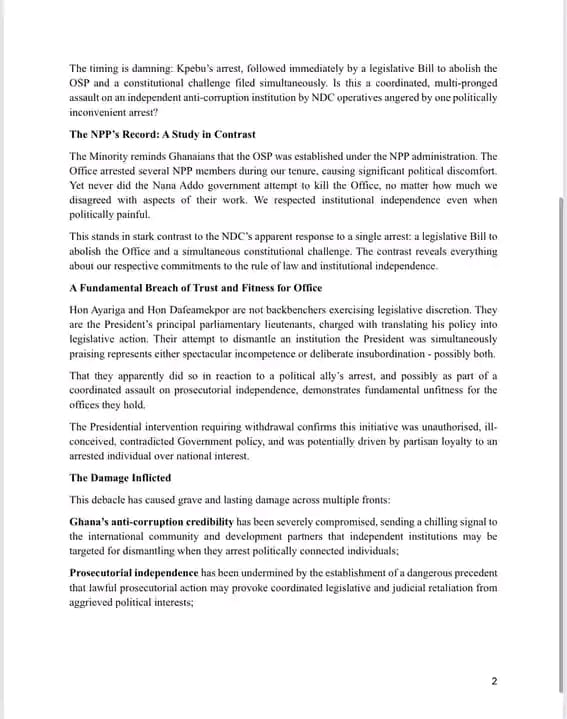
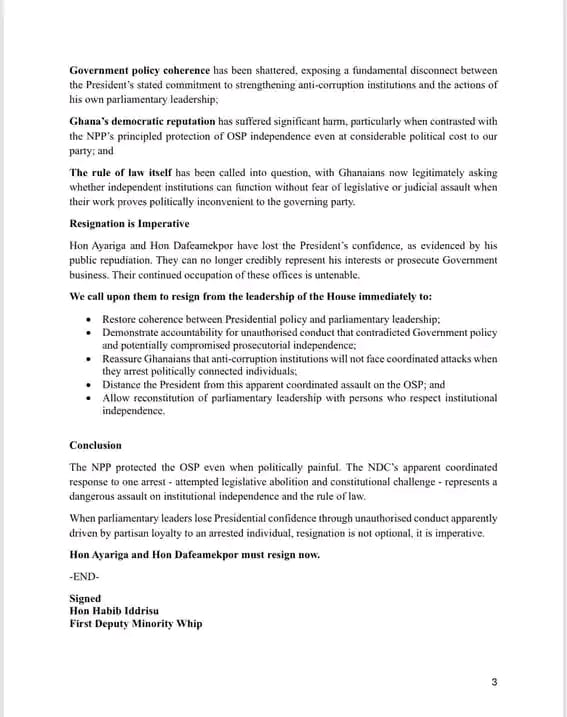
The Minority Caucus in Parliament has demanded the immediate resignation of Majority Leader Mahama Ayariga and Majority Chief Whip Rockson-Nelson Dafeamekpor following the withdrawal of a controversial bill seeking to abolish the Office of the Special Prosecutor (OSP).
In a press release dated December 12, 2025, the Minority said the two MPs sponsored the Office of the Special Prosecutor (Repeal) Bill, 2025, in direct contradiction of the government’s anti-corruption policy and without authorisation from the Presidency.
The Minority stated that the bill, laid on December 8, 2025, sought to repeal Act 959 and transfer the OSP’s mandate to the Attorney-General’s Office. This, the caucus noted, occurred barely two days after President John Dramani Mahama publicly described the OSP as central to Ghana’s anti-corruption architecture.
On December 11, 2025, the Presidency announced that the President had directed the withdrawal of the bill, a development the Minority described as a damaging public reversal.
The caucus raised alarm over what it described as the “damning timing” of the legislation, linking it to the arrest of Martin Kpebu, a vocal critic of the OSP. It questioned whether the arrest of a politically connected individual had prompted an immediate legislative response aimed at dismantling the institution.
According to the statement, concerns deepened when Deputy Attorney-General Justice Sai announced a Supreme Court challenge to Act 959, filed by a private citizen, seeking to remove the OSP’s autonomous prosecutorial authority.
The Minority argued that the bill, the arrest and the constitutional challenge together suggested a coordinated effort to weaken an independent anti-corruption body.
Contrasting the situation with the NPP administration under which the OSP was created, the Minority said the institution was allowed to operate independently even when its actions caused political discomfort.
The caucus accused Ayariga and Dafeamekpor of failing to exercise sound legislative judgement and acting contrary to government policy, stating that the President’s intervention confirmed the initiative was ill-conceived and unauthorised.
The Minority warned that the episode has inflicted lasting damage on Ghana’s anti-corruption credibility and undermined prosecutorial independence, cautioning that it sets a dangerous precedent where lawful prosecutions could provoke political retaliation.