



Faster asset audits & interventions
Many data centres are increasing asset density to support growing demand for computational power, driven by AI and Internet of Things-applications. How are data centres managing all these physical assets?
HIGHER DATA CENTRE ASSET DENSITIES
More apps, more connectivity. Billions of people talking to each other via technology, joined by trillions of things. All that interaction needs computation. Add to that artificial intelligence algorithms that need gigantic, and growing, computational power. These trends have clear consequences for data centre infrastructure. They require more cables. More servers. More ports. Higher density racks. And larger server rooms in bigger data centres.

“How to maintain efficiency for moves, adds and changes on so many assets? That is a question we regularly hear when talking to data centre managers”, said Linda Chochoy, Product Manager Market Development at Brady Corporation, a supplier of automated identification and data capture solutions. “How to keep physical asset audits feasible? How to keep the data centre’s real world, tangible assets aligned with its DCIM or core asset databases?”
“A great, tried and tested way to manage overwhelming and growing numbers of assets is automation with machine readable serial numbers or barcodes. When scanned, they instantly generate digital data and can connect a specific physical asset to the right digital record. The barcode’s advanced siblings, the datamatrix and QR-code, are even better suited for very high density asset environments. They allow data parsing, and enable multiple, automated and fast applications based on the same code. If that is not yet fast enough however, if you need asset identification hyperspeed, label-integrated UHF RFID technology is the nec plus ultra.”
TINY QR OR DATAMATRIX CODES
“The advantage of barcodes is that, when scanned, they instantly generate a digital data trail. But let’s face the truth: barcodes have been around since the 1960’s. In data centres, they take too much space, require labels that are too large, and as a result they can hardly be used to identify each server port separately. Due to their size, they also need considerable cable flag labels to maintain code legibility. All those large flags can create a big mess, certainly in high density racking.”
“Enter the QR-code or industrial data matrix code. Smaller, able to include more information, these codes can be printed in millimeters while maintaining scanner readability. They can fit tiny cable flags and every port in high density servers, routers and switches.”
“To read these codes, classic retail scanners do not suffice. They require high accuracy image capture devices that can include near-field and far-field technology, or a combination of both. Advanced Linux-based scanners exist that feature native JavaScript to enable hundreds of custom, user-defined applications. To create labels for these applications, using tiny, high-resolution datamatrix and QR-codes, high accuracy and high precision label printers are needed that can print 203 or even 600 dots per inch (DPI). Printers can be set up to print asset codes straight from your systems as a QR- or datamatrix code on reliable, machine readable labels.”
THE IMPORTANCE OF TAG AND LABEL RELIABILITY
Some data centre managers have become wary of using labels because of negative experiences. Labels take time to create and apply, and when they are about to pay off, lower quality labels can be found at the bottom of the server rack.
“Labels that cannot stay attached serve no purpose at all. A data centre is a challenging environment that requires professional, quality labels. Server-generated heat is detrimental to lesser label adhesives. In addition, curved cable surfaces require specialised label materials. Brady has researched and developed a range of professional labels made out of nylon cloth and advanced polymers. These labels can keep all data centre cables and components identified. Laboratory-testing, using internationally accepted FINAT- and ASTM-methods indicate they stay attached and remain legible for up to 10 years in data centre environments. That’s more than the lifecycle of most data centre assets.”
5 OUTCOMES FOR WELL IDENTIFIED DATA CENTRES
A well-identified data centre has every cable identified, including all fibre, UTP, power and other utility cables. All server, router and switch ports will also have a unique, coded identity. This enables DCIM or system updates with just two 1 second code scans: scan cable, scan port.
“Well-identified data centres enable 5 considerable benefits:
- More accurate and faster moves, adds and changes (MACs), through faster identification of the right assets, with greatly reduced risk of unplugging the wrong cable
- Faster troubleshooting with clear identification on every cable and asset
- Faster rack and server room audits by scanning physical assets against digital infrastructure records or DCIM-data
- Faster, feasible data centre inventory checks
- More smoothless server rack commissioning and decommissioning
Next to cable and port identification, many higher tier data centres also label transformers, pipes and other infrastructure to increase the speed and precision of a wider range of interventions that may be required to protect uptime and high service levels.”
RFID: A PHYSICAL ASSET RADAR
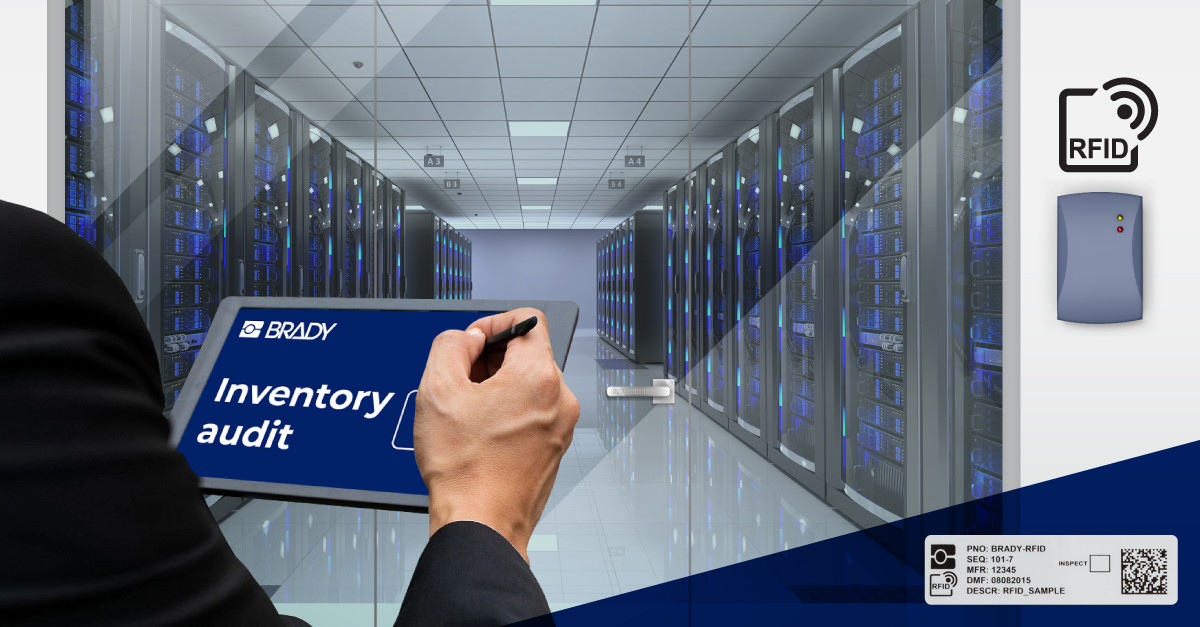
To achieve even higher asset identification speed, RFID technology is the top of the line. Instead of scanning each asset’s code, RFID readers will detect all assets in range in a single scan. Passive, UHF RFID labels do not require batteries and feature thin, integrated antennas that provide up to 15 metres read range in open spaces.
“Brady offers specialised on-metal RFID labels that circumvent known radiosignal distortion from metal surfaces. Read range in datacentres is about 3-4 metres, more than enough to very quickly confirm the presence of labelled assets in multiple server racks in a couple of seconds.”
“The technology works like radar, in a sense that the labels bounce off radiosignals emitted from UHF RFID readers. A portable RFID reader enables users to select a detected asset’s ID number on-screen and to write to that tag or to its record. Through signal strength variation detection, it is even possible to home in on a selected asset with on-board visuals and sounds.”
“There is more. If fixed RFID readers are placed at server room entrances, every labelled asset moving in or out can be detected automatically, along with its movement direction. This makes it possible for data centres to automatically update server room inventory lists, to sound a buzzer or send a text message when the wrong asset moves in or out, and to enable server room inventory checks and audits in a minimum of time.”
WEBINAR RECORDING: DATACENTER LIFETIME IDENTIFICATION
How to optimally support efficiency goals across the data centre life cycle? Discover the role of reliable identification in data centre construction, commissioning, hand-over and lifecycle operations.
Topics:
- Design & build: support compliance, high durability and smart traceability
- Commissioning: enable high speed execution
- Handover: quickly reconcile physical asset labels with digital records
- Lifecycle operations: protect uptime and facility ROI
- Watch the free recording of the data centre identification & traceability webinar.
Download the recording now
Brady Corporation
Brady in South Africa
+27 11 704 3295
africa@bradycorp.com
www.brady.eu
