



What started as a small backyard attempt to find healthier protein for his son has grown into a niche poultry business with two operating branches for Lekgomo Malatjie, founder and CEO of My Big Little Farm.
Based in Laezonia in Tshwane, the 38-year-old quantity surveyor never intended to enter commercial farming when he first bought quail birds in August 2023.
At the time, Malatjie had been vegan for several years and was searching for alternative protein options for his son, who was about to turn two.
The idea of keeping quail came after his wife heard about small birds that could be raised in backyard spaces. As the family lived in a complex where larger animals were not allowed, quail became the practical option.
His wife later sourced cages, incubators and brooders from Howick in KwaZulu-Natal, where the couple travelled to buy their first setup before bringing fertilised eggs back home to hatch.
The birds multiplied quickly, and soon the family had more eggs than they could consume.
The turning point
Curious about whether there could be a market for the products, Malatjie, a yoga teacher, took samples to one of his classes.
One of the students of Asian descent who had earlier indicated they consumed quail eggs, then offered to take him from shop to shop to introduce them to retailers already familiar with quail products.
“I got the shock of my life,” Malatjie recalled. “One shop asked if I had 10 boxes. Another asked for 40 boxes. By the end of the day, I had orders for thousands of eggs that I didn’t even have.”
“I went home and realised the demand was much bigger than my production,” he said.
That moment pushed him to expand beyond a backyard setup. He started sourcing more birds, incubating more eggs and building systems that could sustain larger-scale production.
Today, My Big Little Farm operates from two branches — one in Krugersdorp and another in Centurion, with production divided between egg laying, breeding, incubation and meat processing.
The farm now produces around 3,000 eggs a week and manages roughly 3,200 birds across its operations. Although quail remains the backbone of the business, the farm has also diversified into chickens, ducks and rabbits.
“My plan is to farm a lot of each product properly,” Malatjie said. “But quail is still the main thing because the turnaround time is very fast.”
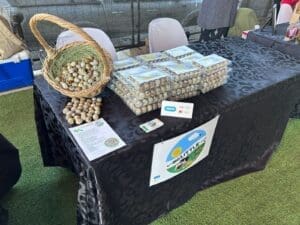
Unlike larger livestock systems, quail can reach maturity within eight weeks, making them attractive for smaller-scale intensive farming.
“There are very few animals where you can participate in almost the entire value chain yourself,” he said. “With quail, you can breed them, hatch them, raise them and process them yourself.”
Despite the business growth, operations remain highly hands-on. Malatjie and his small team begin work as early as 4am every day, checking brooders, feeding birds, managing water systems and collecting eggs.
“The first thing every morning is checking the youngest birds,” he said. “Biosecurity is very important because diseases can spread quickly.”
The farm uses sanitation systems, supplements and water treatments to maintain bird health, while seasonal weather conditions remain one of the biggest operational risks.
“Winter is the hardest season because egg production drops,” Malatjie explained. “The birds still eat the same amount of feed, but production goes down.”
Challenges behind the success
Electricity instability has also become a major challenge because incubators and brooders require stable temperatures to keep chicks alive.
To address this, the business has started investing in solar infrastructure, battery systems and upgraded heating technology. “We realised we needed to improve our systems if we want to scale properly,” he said.
The business currently sells mainly through direct relationships, WhatsApp orders and agents supplying high-end restaurants and niche food markets.
“A lot of the businesses we sell to are actually middlemen supplying restaurants,” Malatjie said.
He believes public awareness around quail products in South Africa is still developing, despite growing demand. “People still ask me if quail eggs taste like normal eggs,” he laughed.
“I always tell them chicken eggs are not the only normal eggs.”
