



Product teams change direction faster than guest-post campaigns close. A homepage can move to a new buyer, retire a feature, or replace its main promise while a publisher is still waiting on a draft. At that point, a Guest Post built from the old brief may contain accurate sentences about a product the company no longer wants to sell. The link can go live and still be wrong.
One BestLinks AI beta customer described changing product direction during the campaign and needing resources picked again. The team adjusted the plan, which exposes an important operating rule: a pivot must reopen upstream choices. Editing a brand name in the last paragraph cannot repair a competitor set, host shortlist, article angle, and target page chosen for the previous product.
The Old Brief Keeps Spending After A Pivot
A campaign brief behaves like a set of instructions. It names the domain, competitors, product claims, target page, anchors, and the audience the company wants to reach. Buyers often treat it as a static form. The publishing queue keeps using those instructions until someone stops it.
That creates a quiet failure after a pivot. The placement fee still buys a real page. The writer still produces a readable article. The publisher may approve it. Yet the page points readers toward an old positioning decision and teaches search engines an association the product team has abandoned. Finance sees a completed order while the growth lead sees rework.
The visible warning is a sentence nobody can approve without adding, “That used to be true.” Treat that sentence as a stop signal. If the product owner could not defend the draft in a current demo, the article should never clear editorial review, even when every link and heading is technically correct.
Find Claims That Belong To Yesterday
Search the queued draft for product category, buyer role, core action, pricing language, and outcome promises. Compare each item with the current homepage and the product screen it describes. A mismatch does not always require a full rewrite, but it always requires an owner. Unowned mismatches survive because every team assumes another person checked them.
Reopen Inputs Before Editing Any Draft
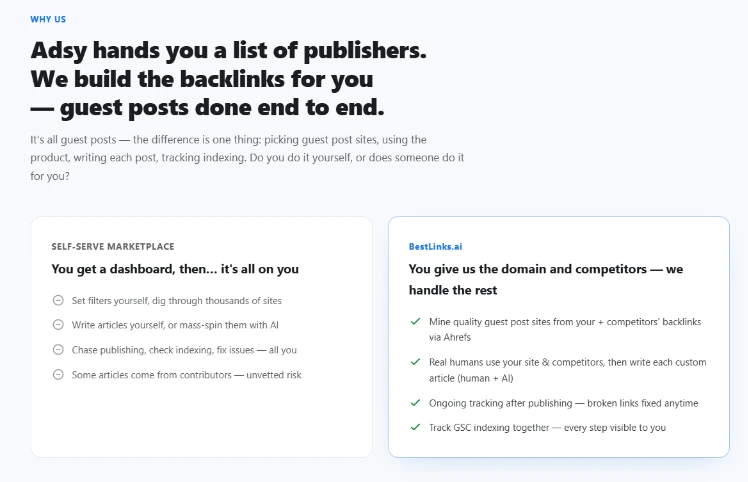
BestLinks AI begins with the buyer’s domain and competitors, then mines candidate publishers from existing and competitor backlink neighborhoods in Ahrefs. A pivot can change both inputs. A tool that moves from consumer photo editing to retail catalog production should not keep benchmarking itself against hobby apps or buying hosts that speak only to casual creators.
Reopening the inputs means more than sending a new tagline. The campaign owner should replace competitors that no longer represent the market, confirm the landing page, mark claims that have changed, and state whether previously approved hosts still fit. The managed team can then rework the shortlist from the new neighborhood rather than forcing the old list to carry a new strategy.
- Freeze unpublished drafts and pending host approvals.
- Write the old position and new position in one sentence each.
- Replace competitors, target page, anchors, and forbidden claims where needed.
- Restart host approval before any writer revises prose.
The order matters. If a writer revises first, the team can spend an afternoon polishing a draft for a host the new product would never choose. Rework belongs after the strategic inputs pass.
Use One Change Ticket Per Decision
A compact change ticket should show the old claim, new claim, affected target page, affected competitors, and which host rows need another decision. Do not bury the change inside a long channel thread. A clean ticket lets the writer, buyer, and publisher coordinator work from the same current state without guessing which message superseded which.
Host Fit Must Survive The New Buyer
The first shortlist was not necessarily bad. It answered an earlier question. After a pivot, each host must answer the new question: does this publication already speak to the buyer and problem the product now serves? DR, traffic, and price remain useful only after that editorial test passes.
| Change | Keep the host when | Reopen the row when |
|---|---|---|
| New homepage wording | The buyer and use case stay the same | The article premise depends on the retired promise |
| New target customer | The host already covers both audiences | The host’s readership belongs to the old segment |
| New product category | The publication has a natural adjacent section | The placement would read like an unrelated advertisement |
| New target URL | The approved angle still leads to that page | The anchor now interrupts the article’s meaning |
A host that fails the new buyer test should be discarded from this campaign, even if the purchase looked attractive before the pivot. Keeping it to avoid a sunk cost often creates a second cost: an article the company will not share and a backlink that reinforces the wrong topic.
Make The Product Owner Approve Again
Final host choice remains with the client in the published BestLinks AI process. Use that ownership again after a pivot. The person who approved the old list may lack authority over the new market, so name the current product owner in the dedicated channel and require a fresh decision. Silence should not count as approval.
Rewrite Claims From Current Product Actions
Once the host survives, the writer needs a current product path. The service says humans use the client’s product and competitors before writing a separate English article for each chosen site. After a pivot, that hands-on step has to start again around the new job. Old notes can preserve terminology, but they cannot serve as proof of the new experience.
A revised Guest Post Service brief should connect each important claim to a screen, action, output, or written rule that exists now. If the new positioning promises team review, the writer needs to see the review action. If the product dropped a consumer mode, the article should not preserve it as a casual example because the paragraph reads well.
This check catches the most expensive kind of stale copy: a sentence that remains plausible. Obvious errors get corrected. Plausible old claims pass through editing and reach a live page, where sales or support discovers them. A public correction then costs more than a fresh draft because a publisher must reopen work that everyone marked complete.
Approve Facts Before Restoring The Voice
Review the factual spine first: buyer, problem, product action, result, target page, and anchor sentence. Style comes second. A fluent article with one retired promise fails the campaign. A plain draft with correct current facts can still be shaped for the host without misleading anyone.
Restart Publishing With A Small Safe Queue
The official process publishes sites one by one. That sequence becomes useful change control after a pivot. Restart with one approved host and inspect the live page before releasing the rest. Check the target, anchor, product category, and current claim language in the published version. A clean first page does not guarantee every later page, but it confirms that the revised instructions survived one full handoff.
Keep the old and new campaign states separate. The shared record should show which rows were frozen, which hosts were retained, which drafts were replaced, and which live URLs belong to the new direction. Without that split, reporting mixes old-position links with new-position work and turns campaign analysis into guesswork.
BestLinks AI continues monitoring live links and can handle broken-link repair, while the client marks indexing in Google Search Console. Neither task should erase the pivot label. A healthy indexed URL can still represent the old product. Status needs both technical health and strategic version.
Give One Person Authority To Restart
A managed campaign can absorb a product pivot when someone has clear authority to freeze and restart it. That person does not need to write every article or inspect every backlink. The job is to declare that the old brief is closed, approve the new inputs, and release work in a controlled order.
BestLinks AI fits teams that want help reselecting resources, rewriting per host, publishing, and tracking, but the provider cannot decide what the new product means. The client must supply that decision. If the company has not settled its buyer or landing page, keep the queue frozen and spend the next hour inside the product discussion rather than inside publisher rows.
A pivot already creates uncertainty. Guest-post operations should not multiply it. Reopen the brief, reapprove the hosts, and let the first new live page prove that the campaign is serving the product that exists today.
