



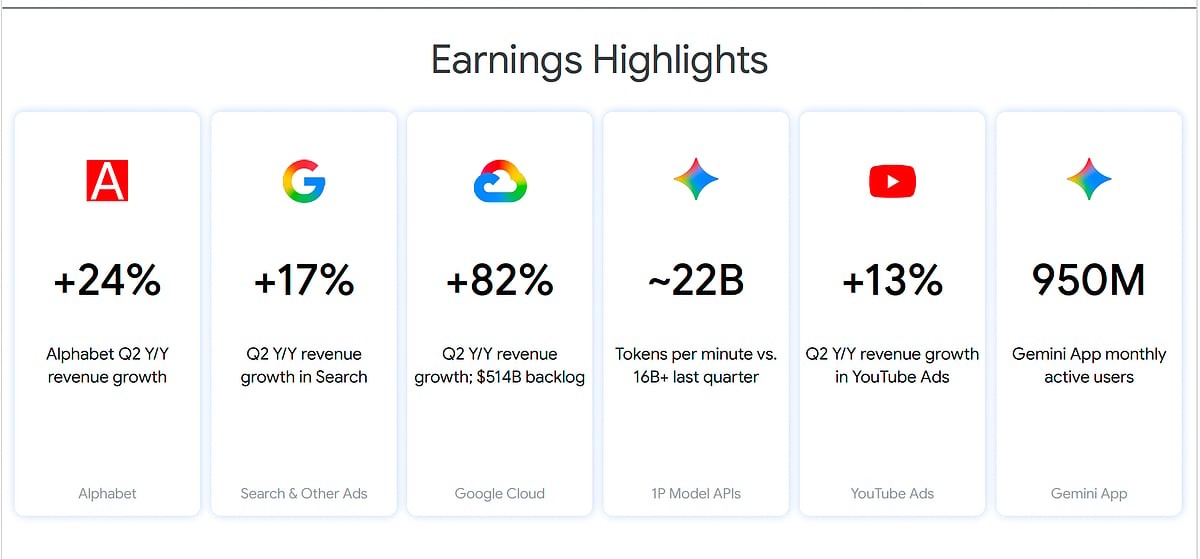
Alphabet just posted its twelfth straight quarter of double-digit growth, with group revenue up 24% and Google Cloud surging 82% and its backlog now $514bn. Yet the stock fell 4% after CFO Anat Ashkenazi raised 2026 capex guidance to around $195–205bn and warned that 2027 spending would rise further still. CEO Sundar Pichai calls the business “supply constrained,” pointing to nearly 500 cloud customers each consuming a trillion-plus AI tokens annually. Unlike Munger and Buffett’s patient, wait-for-the-pitch investing style, Pichai is betting aggressive spending now beats patience in the AI infrastructure race. Despite last night’s blip, for the moment, Mr Market is on his side.
By Alec Hogg
Every May for going on a decade, I sat in what is usually a basketball arena in Omaha listening to Charlie Munger tell 40,000 Berkshire Hathaway shareholders that the trick to compounding wealth is to do nothing. Sit on your hands. Wait for the fat pitch.
His long-time business partner Buffett would nod along, the two of them the living embodiment of patience as a competitive advantage. It is, I’ve always thought, the single hardest lesson in investing to actually practice.
Which is why Alphabet’s second-quarter earnings call, held in the small hours of this morning SA time, made for such a jarring listen. Especially as Alphabet is a cornerstone of the BizNews Ricardo USD portfolio.
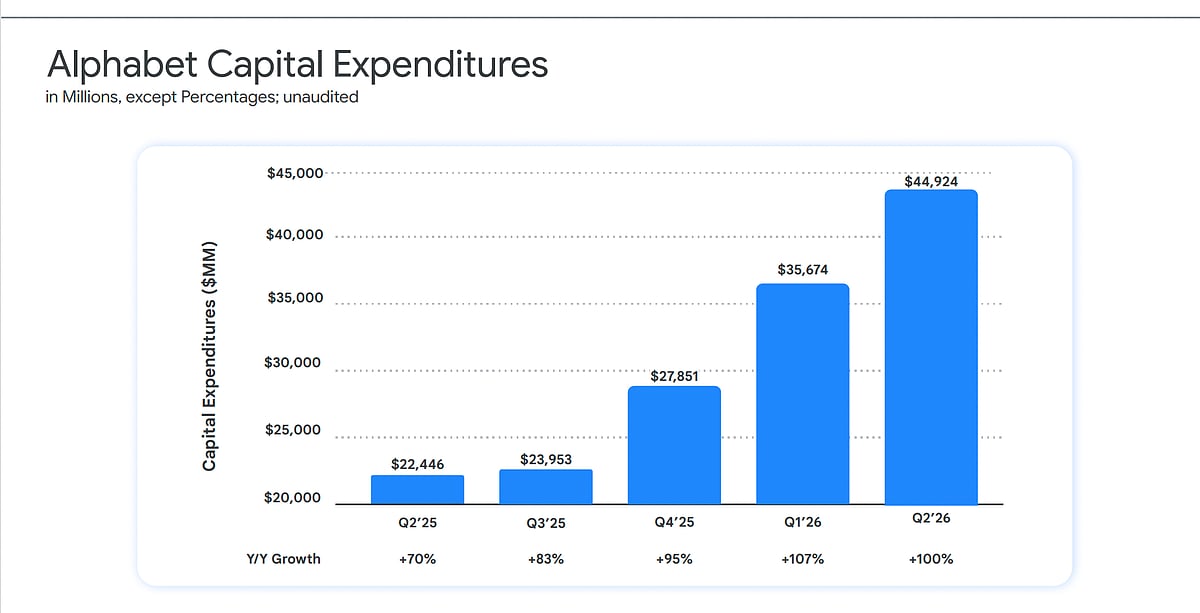
Alphabet bossman Sundar Pichai and his CFO Anat Ashkenazi are doing the precise opposite of sitting on their hands. They are spending $200 billion this year alone on servers, chips and data centres – and telling investors, in effect, that patience is now the enemy.
Let’s start with the numbers for the three months to end June. Because they are extraordinary.
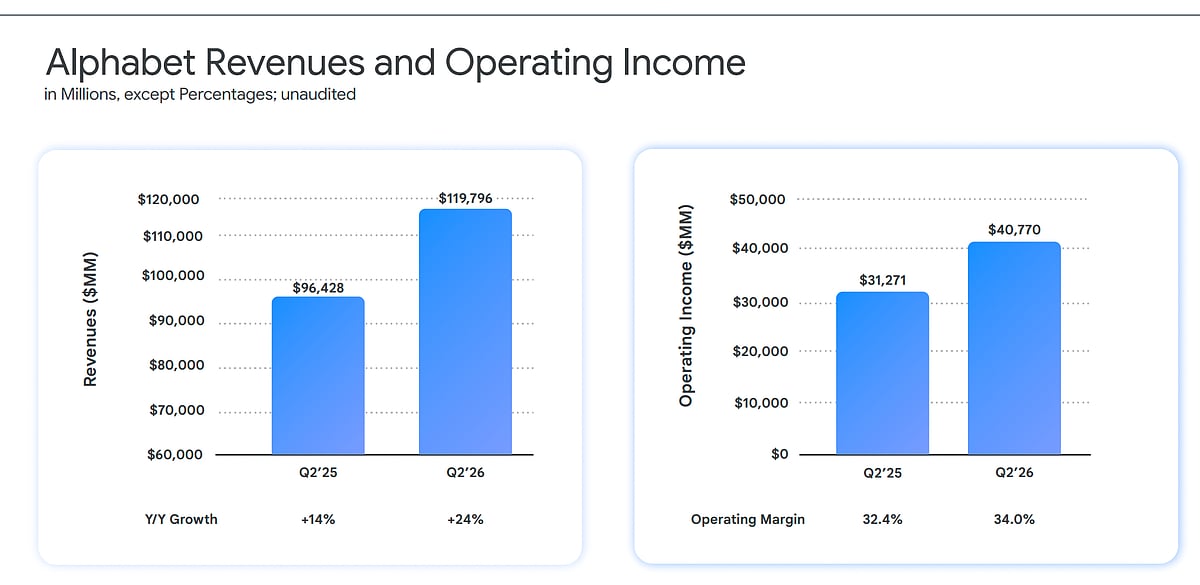
Alphabet’s revenue grew 24% to $119.8 billion in the quarter – the twelfth straight quarter of double-digit growth for a company most people assumed had grown too large to keep doing that. This is exponential. And it ensures the growth assessments underlying our Intrinsic Value model for the stock remain conservative.
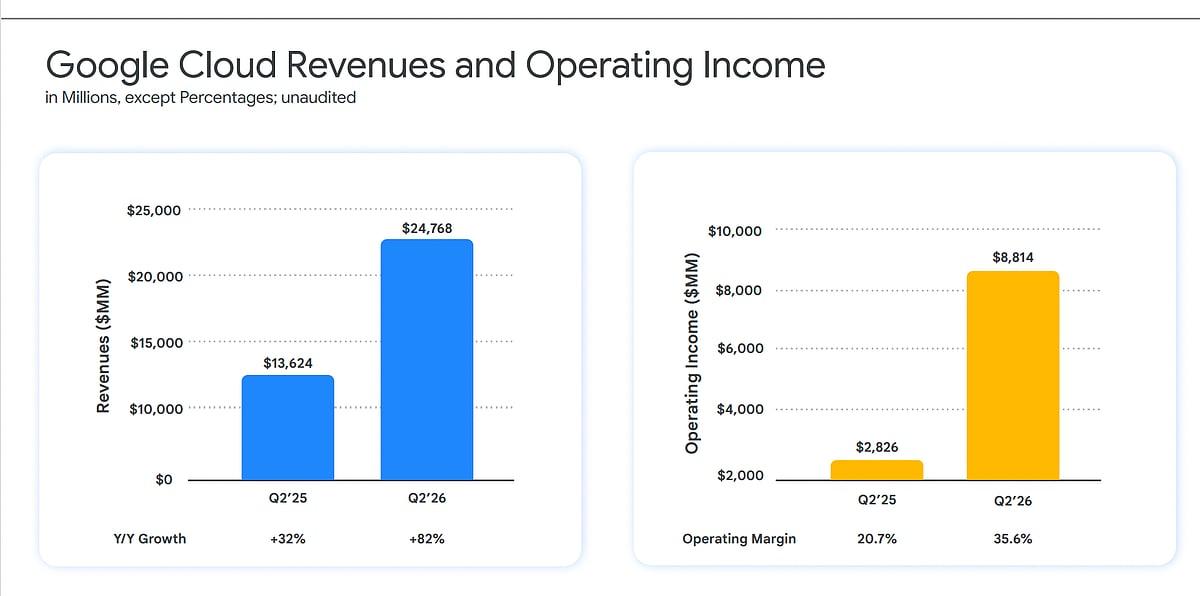
Google Cloud, the unit that for years was Alphabet’s also-ran, is now the star. It grew revenue 82% to $24.8 billion, more than tripling its operating income and lifting the profit margin from 20.7% to 35.6%. Cloud’s order backlog now stands at an astonishing $514 billion, up more than $50 billion in a single quarter.
Look at that in isolation and you have to wonder why the stock dropped 4%. Has Mr Market completely lost his marbles?
Here’s the thing: CFO Ashkenazi told analysts Alphabet is raising its 2026 capital expenditure guidance to between $195 billion and $205 billion – up from $180-190 billion just one quarter ago – and warned 2027 spending will rise “significantly” further.
Those are terrifyingly large numbers when your competitors on the other side of the world are working 24×7 to find ways of doing things cheaper. And China has a pretty good record at achieving just that.
The ambition is already taking a toll. Free cash flow actually went negative in the quarter, by $5.9 billion. The company is ploughing every spare dollar into servers and data centres – faster than it can build them.
This is where Munger’s favourite trick, inversion, becomes useful. Instead of asking whether this AI spending will pay off, invert it: what would it look like if it doesn’t?
A company burning cash to build capacity that the inverted argument assumes nobody wants leads to margins crushed by depreciation and a CFO fielding awkward questions about discipline.
That is not what’s happening at Alphabet. Pichai described a business still “supply constrained” – meaning demand for AI computing exceeds what Google can build, not the reverse.
To back it up, nearly 500 cloud customers have each consumed more than a trillion AI tokens in the past year. Model API traffic has gone from 16 billion tokens a minute to 22 billion in a single quarter. Almost 90% of the Fortune 100 now use Google’s Gemini Enterprise platform.
Pichai’s answer to Morgan Stanley’s Brian Nowak, who asked directly how the return-on-investment calculus had shifted in a year, was telling: “If anything, over the past year, we’ve gotten more bullish on the opportunities ahead.”
That is not the language of a company hedging its bets. It’s the language of one that believes it is still in the “very early innings” of a shift comparable to the move to cloud computing itself – except, as Pichai noted, almost no enterprise workloads have yet gone “AI native”, whereas the cloud migration is largely done.
There is a version of Buffett’s own philosophy buried in this, even if Pichai would never phrase it that way.
Buffett has always said the businesses worth owning are the ones that can reinvest capital at high rates of return for long periods – earnings compounding quietly for decades, largely unseen.
Alphabet’s cloud margin expansion, its Search advertising machine still growing at 17% and again hitting record query volumes (thank the World Cup) point to a company still finding fat pitches to swing at. The difference is that Pichai isn’t waiting for the pitch. He’s building the stadium.
The risk, of course, is genuine.
Depreciation on all that new infrastructure will weigh on the income statement for years to come. Rivals from OpenAI to Anthropic to a clutch of Chinese labs are spending just as aggressively. And side bets like the $2 billion raised by drug-discovery unit Isomorphic Labs, or the self-driving Waymo business now rolling out its sixth-generation vehicle, could yet prove expensive distractions rather than the next Google Search.
Read more:
But for now, the market’s verdict was written in the numbers themselves: operating income up 30% to $40.8 billion, a dividend still flowing at 22 cents a share, and a balance sheet holding $242 billion in cash even after all that spending.
Munger counselled patience. Pichai is betting that in this race, patience is the one thing Alphabet cannot afford – and, for the moment at least, the scoreboard agrees with him. Even Mr Market caught a little post-numbers depression last night.
Sign up for your early morning brew of the BizNews Insider to keep you up to speed with the content that matters. The newsletter will land in your inbox every morning on weekdays. Register here.
Support South Africa’s bastion of independent journalism, offering balanced insights on investments, business, and the political economy, by joining BizNews Premium. Register here.
If you prefer WhatsApp for updates, sign up to the BizNews channel here.
